

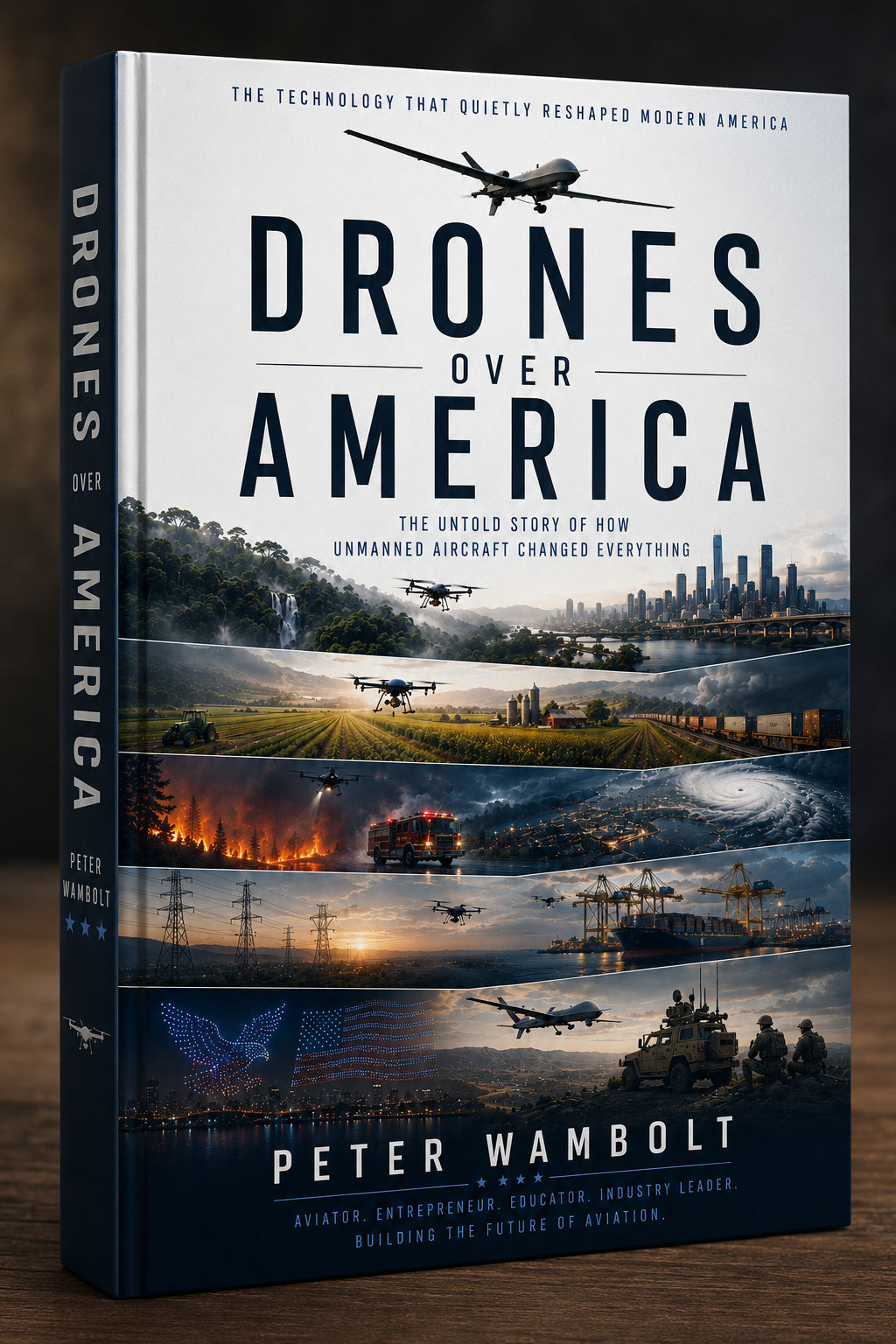
The Untold Story of How Unmanned Aircraft Changed Everything
Much of the drone industry's history has been told through press releases, headlines, and speculation. This book tells the story from the operational side.
Much of the drone industry's history has been told through press releases, headlines, and speculation. This book tells the story from the operational side — where the technology was actually being built, flown, tested, and developed.
I was there when there were no rules — flying FPV drones through city streets, pulling crashed aircraft off rooftops with a ladder I kept in my car, charging commercial clients for footage while the FAA was still arguing over whether we needed permission to exist. I was there when the first regulations arrived, when the first trusted drone lists were published, when the Christmas Eve ban nearly took down allied-nation manufacturers along with the Chinese ones it was designed to target. I've watched this industry go from a hobby shop curiosity to a billion-dollar national security debate — and I'm still watching it shape, right now, in real time. That's why I wrote this book. Not to repeat what's already been published. Not to give you a sanitized version of an industry timeline. But to tell you the story that most textbooks and trade publications never get close to — the one that only makes sense if you were inside it.
What I've Seen
I've briefed generals and commandants. I've stood in rooms and delivered mission briefings for operations I still can't fully describe. I've worked with some of the highest levels of the FBI, HSI, and ICE — explaining what drones could do for federal law enforcement before most local agencies had a drone program at all. I've worked with people whose job titles don't appear on any org chart.
I've trained Navy SEALs, Army Rangers, Green Berets, MARSOC operators, Marines, and special operations units whose specific work is still evolving on the modern battlefield. I've worked with the Japan Self-Defense Force, the French DGA, and military and government organizations across allied nations on both sides of the Atlantic and Pacific. I've traveled on CBP vessels along the border. I've built mission software for commanders running operations on screens most people never get to see. I've briefed congressmen, senators, governors, mayors, and elementary school students on the benefits and security risks of UAS.
I've also helped scientists count seals on icebergs, hovering a drone above ice floes where no human could safely go. I've watched researchers drop tracking devices onto whales in the open ocean from a drone without ever disturbing them. I've helped the Army Corps of Engineers measure coastal erosion. I've helped farms nestled on jungle mountainsides — in Puerto Rico during an earthquake swarm, in Guatemala villages that had never seen an aerial map of their own land — using drone data that gave those farmers their first real view of what they'd worked for generations. I've built custom drones from the ground up for NASA to measure atmospheric wind speed — instruments, not cameras.
I've watched swarms disorient enemies on a battlefield and light up stadium skies as entertainment — hundreds of drones moving in perfect formation, spelling words in light, the audience below looking up with the same open-mouthed wonder I felt the first time I saw a quadcopter hold itself steady in midair. The same technology. Completely different worlds. That's the drone industry in one image — and that's exactly why this story is worth telling.
Where It Started
I planned to be a pilot. When I was eighteen I earned my private pilot's license — not because it seemed like a smart career move, but because of a man I never got to meet. My grandfather Joe flew a C-47 in World War II. He didn't talk about it much. He didn't have to. Aviation got into my blood through him, and it never left.
Then in 2014 my family's home in Marlborough, Massachusetts burned down. I was working on my instrument rating and already flying drones on the side. I watched the fire department respond — working blind, not knowing where the fire was spreading inside the walls, not knowing which rooms were safe. And I thought: if they had a drone up, they could see the heat moving through the roof before anyone inside knew. From then on, drones consumed everything. What I was sketching on a legal pad in 2014 — without knowing the name for it yet — is what the industry now calls Drone as First Responder. The idea was obvious. Nobody had built it yet. So we did.
I went to work for Skyfire Consulting and helped stand up some of the first Certificate of Authorization programs that fire and police departments in the United States ever had. Real programs. Real protocols. Real drones at real emergencies — before Part 107 even existed. It was during those early Skyfire days that I was driving home from a job and passed a house fire. My team had a drone nearby. I stopped. We flew. The images we captured that day ended up in a fire service magazine in 2016 as a vision of the future of firefighting. It may have been one of the first published drone images at a working fire in history. It felt like proof.
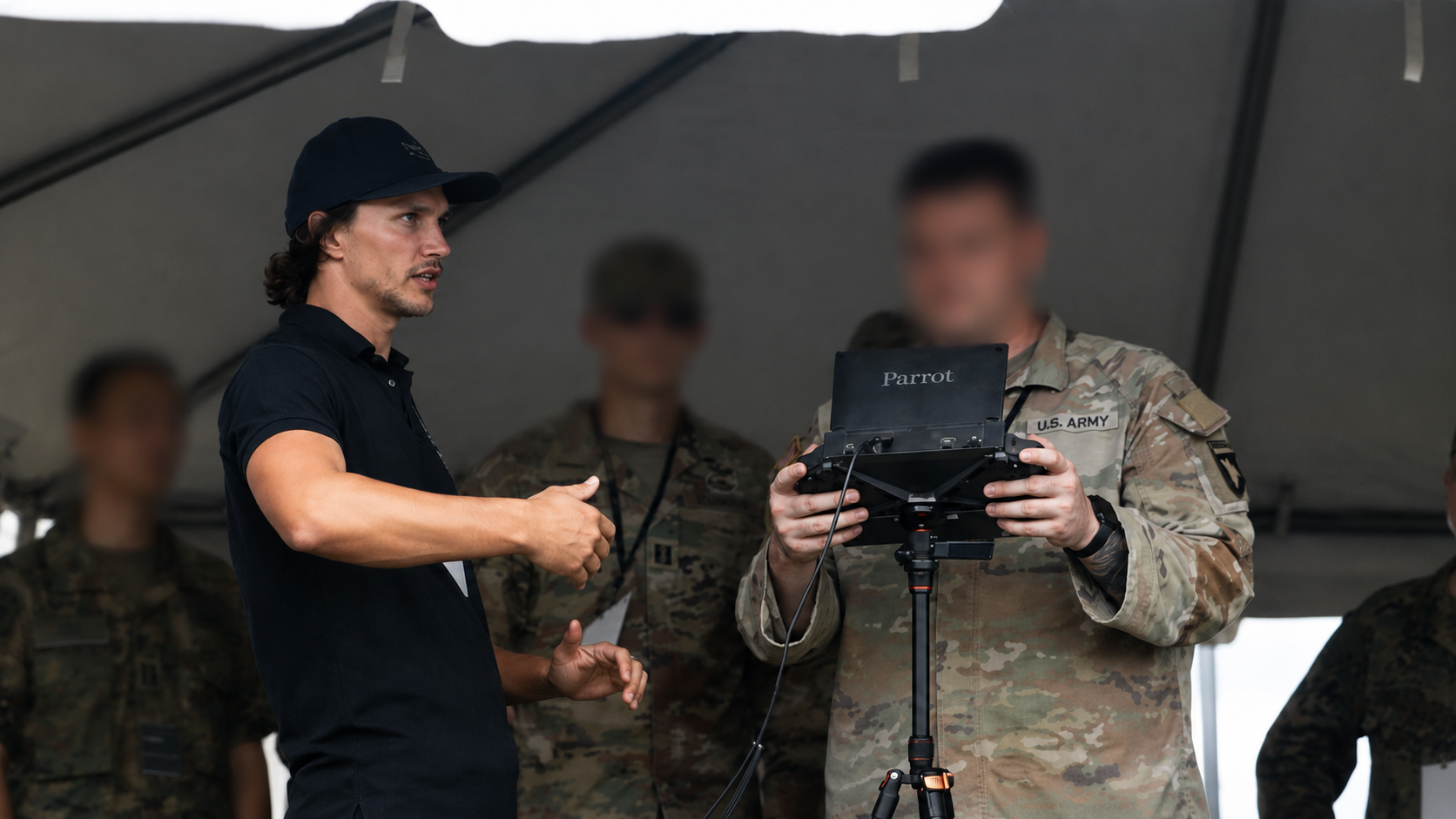
Peter Wambolt with U.S. Army soldiers at a Parrot drone training event. From backyard FPV pilot to military trainer — one career arc that mirrors the industry's entire journey. Source: Author photo — military training image
Why This Book Is Different
There is no shortage of writing about the drone industry. There are white papers and regulatory analyses and press releases and conference presentations and LinkedIn posts. What there isn't — what has never existed — is a modern history of this industry written from the inside. A history that tells you not just what happened, but what it felt like to be in it.
What it felt like to fly commercial jobs without legal cover because the rules hadn't been written yet. What it felt like to watch GoPro and 3DR collapse in real time and know the reasons before the press did. What it felt like to walk into congressional offices explaining that a French drone is not a Chinese drone. What it felt like to watch Ukraine burn through ten thousand DJI Mavics a month and realize that the industry had just changed forever.
What it felt like to watch the money arrive and then disappear — GoPro collapse, 3DR fold, PrecisionHawk raise $136 million and sell for $150,000, Airware vanish overnight with $118 million spent, Lily Camera collect $34 million in preorders and ship nothing. What it felt like to watch Amazon promise thirty-minute drone delivery on national television in 2013 and still be counting total deliveries in the thousands a decade later. What it felt like to watch Intel build the most spectacular drone show technology in history and then quietly walk away. The companies. The capital. The promises. The gap between what was announced and what actually happened.
That's in here too. All of it. Let's go.